- Sponcon Sports
- Posts
- The Creator System Most Teams Lack
The Creator System Most Teams Lack
How social listening turns fans into a scalable creator engine

Alex Kopilow
January 08, 2026
👋 Welcome back to Sponcon Sports, a weekly newsletter dedicated to sponsored content strategy in the sports industry!
December 29 was a big day for LEGO in sports marketing.
Fresh off earning my Digital Partnership of the Year in 2025, the brand didn’t ease into the moment. Instead, LEGO activated across athletes, creators, and athlete-led media—each playing a distinct role. Just as importantly, each partner authentically embodied LEGO’s core idea of creativity through play, not as a one-off, but as something already baked into who they are.
Athlete partnership (1 post): WNBA Rookie of the Year Paige Bueckers announced her LEGO deal with a side-by-side portrait: one real, one built entirely out of bricks.
Creator partnership (2 posts): Dude Perfect dropped a custom edition of its successful If Every Sport Used ___ format, placing LEGO bricks right in the middle of the action.
Athlete media partnership (18 posts): LEGO also teamed up with Quadrant—the entertainment, gaming, and apparel brand founded by Lando Norris—for a LEGO-themed karting challenge to crown the fastest YouTuber. Hosted by Norris himself, 17 clips rolled out across YouTube Shorts, Instagram, TikTok, and Facebook.
The results followed: 7M+ views and 510K engagements. Each partner delivered something different.
Bueckers drove engagement (127.2K), producing 35% more interactions than any other post. Dude Perfect delivered views with 5.3M views. Quadrant blended both. Nearly 2M views (1.8M) and 226.1K engagements across platforms.
The views/engagement weren’t the only wins, it was showing how a single brand idea can flex across talent, formats, and platforms without losing its core message. LEGO didn’t bet on one big name; they built a system where each partner played a specific role in driving reach, engagement, and storytelling.
In Today’s Edition:
Creator Flywheel Construction 🔃
Fast Balls, Smart Glasses 😎
Chiefs Roll For Engagement 🧙
🤝 SPONSORED BY PRIORITY PARTNERSHIPS
New Study Coming Soon
Youth sports has been sponsorship’s sleeping giant. That’s about to change.
Priority Partnerships commissioned a national study, conducted by YouGov Sport, to deliver one of the most comprehensive looks at youth sports sponsorship to date.
The report digs into:
✅ How parents and consumers respond to youth sports sponsorship
✅ How youth sports stacks up against traditional sponsorship channels
✅ The impact on brand trust, consideration, and sales
The report drops this month.
Pre-register to get it delivered straight to your inbox. 👇
🏊️ DEEP DIVE
The Real Unlock in Creator Marketing
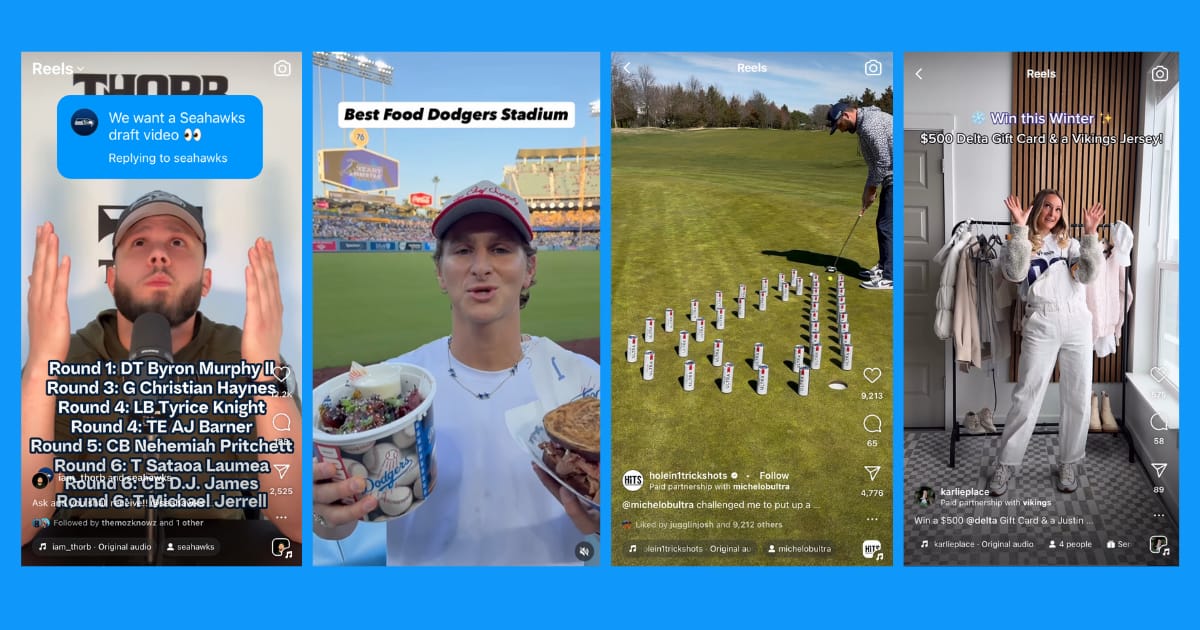
Most sports teams treat creator or influencer marketing like a one-off tactic.
There’s a campaign on the calendar. Someone asks, “Can we get a few creators involved?” And suddenly the process starts from scratch: searching platforms, debating fit, negotiating budgets, and hoping the content lands.
Creator marketing shouldn’t be something you rebuild every time you want to use it. It should be a system.
Like building a real digital partnerships inventory, this approach takes more work up front. But once it’s in place, everything downstream gets easier: execution speeds up, internal debates shrink, and creator marketing becomes something the entire organization can rely on — from ticketing and merchandise to brand, partnerships, and comms/PR.
I learned this system years ago working in agency environments, where discovery had to be fast, defensible, and scalable across clients. It was rooted in two things: social listening and documentation. And it’s a system I still swear by, because it replaces guesswork with signal.
Why the Current Creator Model Breaks Down
The best creators to work with almost always have an authentic connection to the team.
They already talk about the club. They show their fandom organically. They show up in comments and replies. Other fans recognize them. The problem is that connection rarely shows up in a bio or media kit, which makes them invisible if you’re only searching when you need them.
That authenticity matters for two reasons:
The content feels more credible to fans
The creator is more invested, often opening the door to flexibility on budget and scope
There’s also a reality most teams underestimate: good creator marketing takes time.
Yes, there are tools, marketplaces, and agencies that can surface creators. But they rarely deliver people who work long-term, because they don’t know your audience the way you do. The stronger your creator roster is, the less time you waste internally — fewer debates, fewer approvals, fewer explanations to brand partners about “why this person.”
And then there’s the biggest structural issue.
On many teams, the deepest fan insight lives entirely inside the social media team. Without documentation or a shared system, that knowledge walks out the door with turnover. The organization resets and starts from scratch.
A creator system fixes that.
How To Build A Creator Marketing System That Actually Scales
Step 1: Establish Ownership (and Shared Accountability)
This system needs a clear owner, someone focused specifically on creator or influencer marketing. If you need validation, take it from Sarah Adam, Wix’s Head of Influencer Marketing, who consistently shares smart, practical insight on how this function should operate.
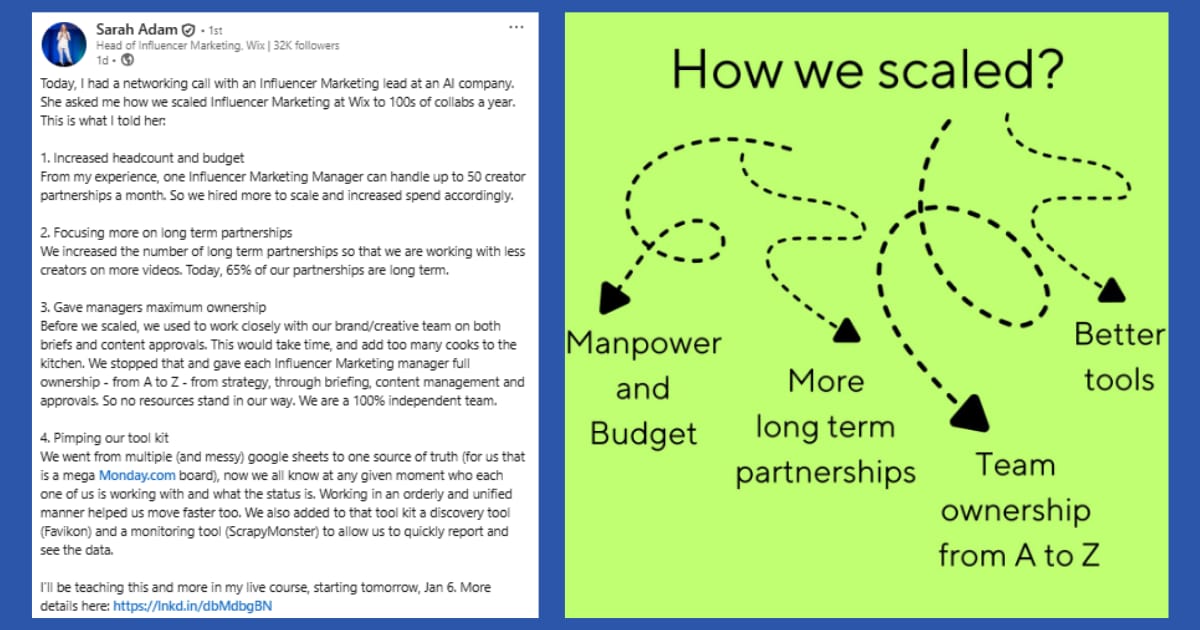
That person shouldn’t work alone. The system should be supported by representatives from:
Social
Partnerships
Brand
Ticketing
Merchandise
Comms / PR
This is also an ideal place to involve interns and associates. The work is observational, detailed, and incredibly valuable when done consistently.
At this stage, you’re not activating creators. You’re building intelligence.
Step 2: Automate the Listening
Once the team structure is in place, here’s how the system actually works.
Start with a social listening tool of your choice. Most social content management platforms — Sprinklr, Sprout Social, Emplifi, etc. — already have these capabilities built in.
The first part of this process should be automated.
You want social posts to surface that:
Tag your team’s social accounts
Include relevant keywords such as:
Team name
Players
Merchandise
Venue
Venue experiences and offerings
Marketing campaign identifiers
From there, filter those posts by follower count:
10K–50K
51K–100K
101K–500K
501K–1M
1M+
This ensures you’re paying attention to creators at different stages, not just the biggest accounts.
Step 3: Review and Engage Daily
Every business day, the cross-functional group outlined above should meet first thing in the morning to review mentions and decide if, and how, to engage.
Engagement should be intentional:
Like
Comment
Send a custom gift
The goal isn’t just interaction. It’s brand building via earned media.
Fans are excited when teams notice them and take the time to engage. That excitement often turns into follow-up posts, and additional conversation — all of which extend reach organically. More importantly, these interactions begin building relationships that can turn into future partnerships.
The person leading these meetings should be empowered to approve and execute engagements on the spot. Pro Tip: make sure you’re vetting these fans before engaging. If something feels off — brand safety concerns, risky conversations, or gray areas — elevate it to a department head or someone on the PR/comms team.
Speed matters, but so does judgment.
Step 4: Document Everything (This Is the Real Unlock)
Once engagements are executed, document them.
Please don’t use a Google Sheet or Excel file. At a minimum, use something more secure and flexible like Airtable. Ideally, work with your Business Analytics team to build this directly into your CRM so the entire organization can access and benefit from it.
What should you document?
Creator or influencer name
Links to social channel(s)
Link to the post, comment, or screenshot that drove the engagement
Date of the post
Link to the team’s engagement (if applicable)
Topic of conversation
Wins: how the creator responded (did they post about the engagement? did their audience react?)
Why does this matter?
You now have a living database of people who have already demonstrated affinity for the team, with specifics around what they care about and how they express that fandom.
Because they posted unprompted, and because their audience responded positively, these creators are strong candidates for both earned and paid partnerships. Outreach response rates improve dramatically when you can reference a specific moment and show that you were paying attention.
This content can also fuel future campaigns.
If a fan is waxing poetic about a throwback jersey and you know it’s coming back, that comment becomes social proof. Quote it. Share it. Use comment-to-video features when you announce the news. You’re not just launching something, you’re showing fans you were listening.
Bonus Tip: Create a private Instagram account (or equivalent on other platforms) that follows every fan or creator you’ve engaged with — even if the original interaction happened elsewhere. This gives you an easy way to tap through Stories and catch things social listening often misses, like whether someone shared a gift you sent or posted about the team organically.
You can also layer in tools like ManyChat to capture and manage Story mentions more intentionally, especially when fans tag the team but don’t post to their feed.
Step 5: Use the System to Accelerate Approvals
This documentation also changes everything with internal senior leaders and external brand partners
Whether a creator is being considered for earned or paid work, you will eventually have to justify why they were selected.
Pro tip: Influencer recommendations should always include:
Who they are
Follower counts on relevant platforms
Audience demographics (age, gender, location)
Performance averages (e.g. views per post, engagement rate)
Why they work
Links to example content showing how the team or brand partner could appear
That “why they work” section is where this system pays off.
Past engagement is a powerful signal. It demonstrates authenticity, openness to partnership, and the type of content you’re likely to get. If a creator posted an unboxing video of a custom gift you sent, that’s proof of earned performance and future potential.
The clearer your case, the faster approvals move — and given how often creator campaigns come together on short timelines, every second counts.
Step 6: Spot Opportunities Beyond the Calendar
The final benefit of this system is that it doesn’t just support what’s already on your marketing calendar. It helps you identify new opportunities as they emerge.
If you’re a baseball team and notice fans attempting the 9-9-9 challenge (nine hot dogs, nine beers, nine innings), that’s a trend worth paying attention to. The Philadelphia Phillies leaned into this by creating a limited-edition menu item. You could then use creators who attempted the challenge to become natural amplifiers.
That’s the difference between reacting to creators and building a system that works for you.
The Takeaway
Most teams are still starting from scratch every time they want to work with creators. The teams that win long-term build systems: they listen consistently, document what they learn, and let creator marketing compound instead of reset.
Treat creator marketing like infrastructure, not a one-off.
Office hours are open! I’m offering free 30-minute sessions to troubleshoot digital partnership challenges, brainstorm ideas, or discuss strategy. Grab a spot and let’s tackle whatever’s top of mind.
🔍️ SPONCONSPIRATION
Steal These Ideas
Ever wonder how fast a JUGS machine can fire a football at an NFL player? Amon-Ra St. Brown put that curiosity to rest in a sponsored post for Oakley Meta AI Glasses, letting fans experience the speed from his POV.
We’ve already pointed out how Sherwin-Williams has been a natural fit for the Jacksonville Jaguars’ uniform combo posts this season. But this throwback jersey edition took it a step further, elevating the brand’s integration within the series.
Move over fantasy football. Enter Dungeons & Defense. Six Kansas City Chiefs players went on a Dungeons & Dragons quest led by Dungeon Master and creator @itsAnnaMargaret, with Microsoft tablets (+Copilot branding) woven throughout. The most impressive part? Fan reaction. This dropped right after KC missed the playoffs for the first time in a decade, and the comments were still overwhelmingly positive.
Visit Dubai sponsors Real Madrid C.F.’s “Photos of the Month” series, and it sparked an idea for the category at large. What if the photos selected for social were also turned into physical postcards fans could actually send from Dubai?
Speaking of tourism boards, Visit Maine scored serious social value from the launch of Portland Hearts of Pine’s new Lighthouse Kit, featuring USMNT legend Landon Donovan as the face of the reveal.
As New Era Cap’s Director of “Billustration,” Buffalo Bills QB Josh Allen has been wearing custom hats to home games designed by patients at Buffalo’s Oishei Children’s Hospital. Each hat is auctioned to support the Patricia Allen Fund—and the program has raised over $100K this season.
Not a subscriber yet? Join over 3,500 sports industry professionals, from the NFL to the Premier League, who read Sponcon Sports weekly to learn about sponsored content strategy in sports.
🚨 ICYMI
What To Watch For
Build For YouTube: If YouTube audience growth is on your 2026 priority list, Paddy Galloway’s one-page YouTube strategy is a must-read. It clearly outlines the level of focus and commitment creators actually need to win on the platform.
Not Just Booths: Evan Eckman breaks down why experiential marketing works best when brands own the moment. That means choosing (or creating) environments they can lead, solving real attendee pain points, and extending the experience before and after the event, rather than just showing up alongside everyone else.
Follow Through: Ever wonder if directly asking people to follow you in content actually works? Tyler Webb tested it and shared a clear case study on whether the tactic drives results and how to integrate it without feeling forced.
Emojis, Explained: Zoomph analyzed the most-used emojis by U.S. pro sports teams and leagues on social media in 2025, and what those choices reveal about content strategy over the past year [h/t Dan LaTorraca].
Snap Into 2026: Kahlen Macaulay explains why Snapchat believes 2026 will be sports’ most connected, and branded, year yet.
🏃BEFORE YOU GO
How I Can Help You
Digital Partnership Overhaul: I help partnership leaders fix undervalued digital inventory and install the valuation and packaging systems that unlock $5–10M in revenue—especially inside organizations where sales and content operate in silos.
On-Call Deal Support: I plug in as a digital partnerships specialist during key sales windows, helping teams win new business, renewals, and upsells with stronger decks, smarter packaging, and digital-first ideas that actually perform.
Workshops That Fix Workflow & Content: I train content and partnership teams to collaborate better, generate fan-first sponsored content, and scale digital without burnout—leaving them with clearer processes and repeatable systems.
P.S. If digital revenue or next season’s targets are top of mind, reply to this email or book a free 30-minute intro call.
Reply