- Sponcon Sports
- Posts
- A 71% Brand Lift, Wasted
A 71% Brand Lift, Wasted
The hidden failure inside most community partnerships

Alex Kopilow
January 29, 2026
👋 Welcome back to Sponcon Sports, a weekly newsletter dedicated to sponsored content strategy in the sports industry!
You can’t plan a Manchester derby win, but you can plan how to maximize it.
That’s exactly what Manchester United did with Snapdragon.
From the win over Manchester City alone, the partnership generated five Instagram posts that pulled in more than 25.7M views.
We’ve talked before about the baseline DNA of why phone-sponsored, field-level highlights work so well:
They feel native to social, like a fan capturing the moment themselves
The brand is attached to already high-performing content
The “Shot on Snapdragon” lockup stays out of the way while still doing heavy lifting for the product story
The camera quality speaks for itself by clearly capturing fast, emotional, high-speed moments
But last week, United took the partnership well beyond the two goals (Goal 1, 4.5M views | Goal 2, 12.8M views) posted on match day.
Two days after the win at Old Trafford, the club dropped an alternate angle of Patrick Dorgu’s goal (5.3M views) to keep the post-win buzz alive. A few days later, they shared another alternate angle, this time of Bryan Mbeumo’s goal (2.2M views), to spark that same fan enthusiasm as the team prepared to play Arsenal next.
By positioning staff on both sides of the net, United was able to repurpose those same moments and drive 43% more views compared to match-day content alone.
The cherry on top? That footage didn’t stop at highlights.
Over the weekend, the club rolled it into a fan-focused feature (940K views) with Shanmukh Sripada, a sports artist and lifelong Red, who attended his first-ever match at Old Trafford…which just so happened to be the derby.
The piece showcased a Manchester United–inspired painting he created with help from a Snapdragon tablet, while documenting the journey and once-in-a-lifetime emotion of that win on a Snapdragon phone.
While the win against Man City undeniably raised the ceiling for performance, luck wasn’t what stood out here. Manchester United was prepared for the moment, and when spirits were high, they extracted maximum value from match-day goals, turning a single moment into a full week of high-performing, sponsor-backed content.
In Today’s Edition:
Community Content That Sticks 🥰
New Balance Off-Court Chemistry 🎾
BYU Schedule Served Cold 🥤
🤝 SPONSORED BY PRIORITY PARTNERSHIPS
New Study Available Now

Available now! The ROI of Sponsorship in Youth Sports Report delivers one of the most comprehensive looks at youth sports sponsorship to date.
Commissioned by Priority Partnerships with research conducted by YouGov Sport, the report digs into:
✅ How parents and consumers respond to youth sports sponsorship
✅ How youth sports stack up against traditional sponsorship channels
✅ The impact on brand trust, consideration, and sales
The report is free to download. 👇️
🏊️ DEEP DIVE
How To Make Community Content Fans Remember
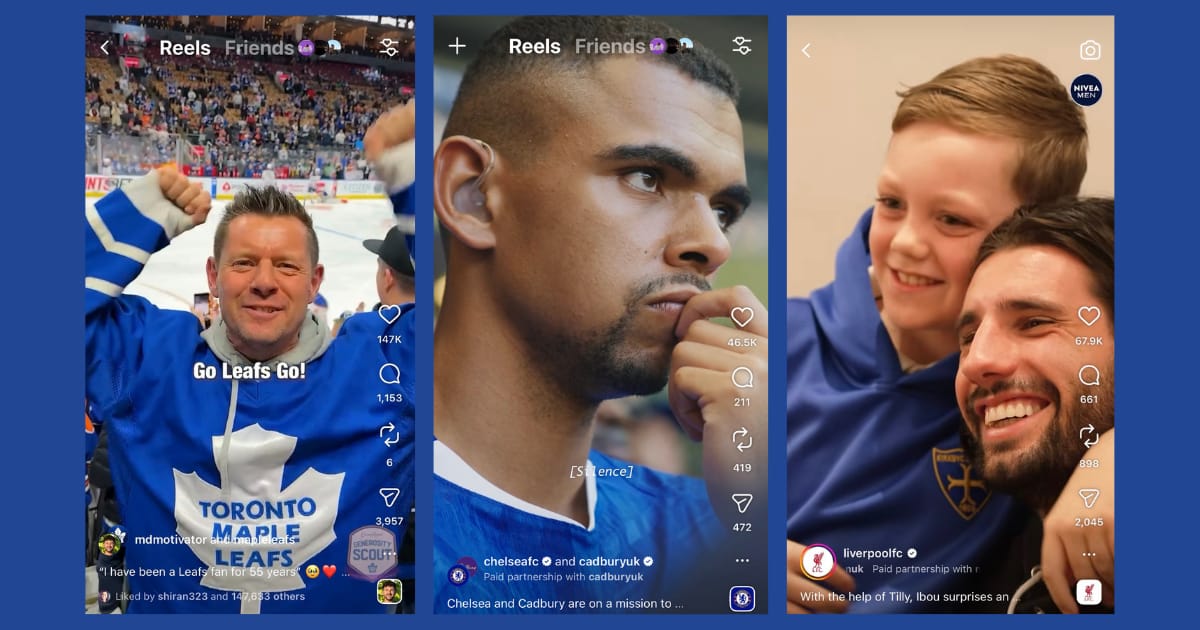
There’s a 71% brand equity opportunity sitting inside community partnerships.
And most brands are letting it slip away.
According to new data from Wakefield, brand equity increases by 71.4% when fans recognize a brand’s commitment to the community through sponsorship.
That’s not a soft metric.
Brand equity drives preference, trust, pricing power, and long-term growth. It influences market share, customer lifetime value, and even stock performance. In other words: it’s one of the most valuable outcomes a sponsorship can deliver.
But there’s a catch.
That 71% lift only happens if fans actually notice the brand’s community commitment.
The upside isn’t created by doing community work alone. It’s created when the work is recognized, remembered, and associated with the brand.
And that’s where most partnerships quietly fall apart.
Teams and brands invest real time, money, and intention into community initiatives. The work itself is often meaningful. But the way it shows up in feeds? That’s usually an afterthought.
A recap video.
A few Instagram Stories.
Maybe a logo’d photo carousel.
Box checked.
But if those posts don’t travel, don’t resonate, and don’t get remembered, they aren’t building brand equity. They’re just documenting that something happened.
It’s the classic question: If a tree falls in a forest and nobody is around to hear it, does it make a sound?
The real problem isn’t purpose. It’s memorability.
The Wakefield data makes this clear. Fans who don’t recall a sponsorship barely associate the brand with community commitment. Fans who do recall it? Nearly a 2.5x increase.
Recognition is the multiplier.
Organic social should be the place to create that recognition. It’s where teams already have attention, trust, and built-in distribution. But it’s also where community content most often underperforms.
Why?
Because rightsholders default to content designed to record an event, not content designed to earn attention.
Who actually wants to watch a recap of something that already happened, especially when it’s overly branded and emotionally flat?
Instagram Stories aren’t the villain here. They’re underrated in reach and engagement. But they disappear in 24 hours, which limits memorability and shareability even when the moment is strong.
Bad content about a good initiative doesn’t just underperform. It wastes the very equity the partnership was supposed to create.
So how do you make community-focused content memorable?
The same way you make any content work.
There aren’t special rules just because it’s purpose-driven.
Before anything goes live, it should pass two tests:
Does this match what the audience expects when they hit follow or subscribe?
Does it provide value — entertainment, education, emotional connection, or utility?
For community initiatives, emotional connection is usually the strongest lever.
Not the check presentation.
Not the ribbon cutting.
The human moment that makes someone stop scrolling.
That’s the difference between “nice work” and “I’ll remember this brand.”
What memorability looks like in practice
Here’s what memorability looks like when teams get it right:
Liverpool FC x NIVEA Men: In Dear Liverpool FC, Liverpool and NIVEA Men turn fan-nominated everyday heroes into emotional, surprise-and-delight moments with players, then scale those moments across long and short-form content that consistently performs.
Norwich City FC x Samaritans: Norwich City paired a powerful World Mental Health Day video with a full-club takeover — donated shirt sponsorships, auctioned match-worn kits, and women’s team integration — making the cause impossible to miss.
Arsenal x Persil: Persil used the Women’s North London Derby to normalize period stains in sport, surrounding a massive crowd with an integrated message across LED boards, programming, and player-led storytelling that extended far beyond matchday.
Paddy Power x World Darts Championship: Paddy Power subtly blurred its in-arena logo to raise awareness for a player’s eye condition, proving that a smart contextual twist on an existing asset can spark conversation without overpowering the moment.
Chelsea FC x Cadbury: Chelsea and Cadbury made inclusion tangible by installing British Sign Language interpreters at every men’s and women’s home match, ensuring deaf fans are never left out of the experience.
Newcastle United x Sela: Newcastle United and Sela invited young deaf fans to be mascots, then donated the front-of-shirt sponsorship to RNID, capturing an emotional moment that clearly connected cause, club, and partner.
Golden State Warriors x Rakuten x Stephen Curry: Rakuten turned Warriors tunnel-walk content into a platform for emerging Black designers (see Sponsored Content of the Week), using Stephen Curry’s arrival fits to blend culture, commerce, and community across multiple channels.
Buffalo Bills x New Era x Josh Allen: As New Era Cap’s Director of “Billustration, Josh Allen’s custom, patient-designed hats — worn to games and auctioned for charity — transform a weekly arrival moment into a recurring, fan-loved community program that’s raised over $100K.
Toronto Maple Leafs x Crown Royal: The Maple Leafs and Crown Royal used creator-led storytelling (See Sponsored Content of the Week) and a genuine act of generosity to turn a contest into a viral, emotionally driven moment that outperformed traditional promotion by orders of magnitude.
Chicago Bulls x Advocate Health Care: The Chicago Bulls invited an Advocate Kids patient and their family to meet the team and join them on a road trip. The experience included a special surprise from Derrick Rose, who attended the same high school as 15-year-old Delvin.
This work has to start earlier than most teams think
One of the biggest missed opportunities happens before a partnership is even sold.
Community ideas are often finalized in sales conversations without meaningful content input. Then the event happens. Then the content team is asked to “capture it.”
That’s backwards.
If you want community initiatives to drive brand equity, someone from the content team needs to be in the room while the partnership is being pitched. Not to dictate tactics, but to identify:
The emotional moment that will thrive on social
What format fits the platform
Which channel gives the idea the best chance to travel
And content shouldn’t be the only voice added.
The strongest community programs are shaped collaboratively:
Community teams understand the cause and credibility
Comms teams know what’s newsworthy
Player relations surface authentic connections (current or retired)
Content teams know what will perform and where
That mix is how good intentions turn into memorable moments.
Zoom out: social isn’t the only lever
Organic social is often the default for where community initiatives live, but it shouldn’t be the only place they show up.
If recognition is the goal, teams need to think more holistically about where fans discover, revisit, and remember these programs.
Here are the other levers worth pulling.
Team website and mobile app (owned foundation): Your owned platforms are where community initiatives should live permanently, not disappear after a post underperforms. At a minimum, add the program to your community page; if it’s expansive, consider a dedicated hub with donation trackers, fan sign-ups, and event schedules — and give the partner full share of voice through a banner takeover.
Team community accounts: Followers of community-focused accounts expect this content, which means higher relevance, stronger engagement, and less friction around purpose-driven storytelling.
In-venue (live moments): On-field ceremonies, videoboard features, and concourse or fan-zone activations legitimize the initiative and connect it to the live game experience.
Broadcast: If your marketing team has access to broadcast ad reads or integrations, use them. Promoting the program during live games — and linking to the website or app hub via QR code — expands reach beyond social and reinforces credibility.
Earned media: Looping in your comms team early allows you to identify what makes the initiative newsworthy and which outlets are most likely to care, turning a community program into a story, not just a post.
Paid social media (amplification layer): Paid social lets you target specific audiences, exclude users who already saw the organic post, and efficiently scale reach. The better the organic creative, the cheaper this becomes.
Athlete and creator marketing: Find athletes or creators with a genuine connection to the cause and let their voice do the work. With the collab tool, teams, brands, and creators can now share distribution without sacrificing trust.
Brand-owned channels (O&O): The brand should be telling this story too. If content doesn’t feel right for team channels, teams can still capture and edit it for the brand to distribute across its own media plan.
Donation triggers: Tying in-game actions to donations is powerful, but these programs are often overly reliant on organic social alone. When structured and promoted correctly, donation triggers become repeatable moments fans remember, not background noise (see my donation trigger playbook and this recent Kansas City Chiefs case study).
Asset Pass-Through: Allow brands to pass along their sponsorship assets (signage, jersey sponsorship, etc) to charities or nonprofits, giving those organizations added visibility and awareness.
The Takeaway
Community initiatives don’t drive brand equity on their own. Recognition does.
If fans don’t see it, remember it, or emotionally connect with it, the impact stops short of the business outcomes brands are actually paying for. The work matters, but making it memorable is what turns purpose into equity.
Got Partnership Questions? I’m offering free office hours for anyone looking to brainstorm, solve workflow challenges, or discuss digital revenue strategy.
🔍️ SPONCONSPIRATION
Steal These Ideas
Really smart move by New Balance to leverage non-tennis athletes within its Australian Open partnership. In From the Stands, they mic’d up Pat Cummins (Australian cricket captain) and Francisco Lindor (New York Mets shortstop), letting fans listen in on their courtside conversation during a match.
This BYU Football schedule release, turning their 2026 opponents into Swig Drinks, was perfectly on brand. What I’d like to see next? Discounts tied to each drink during the week of the corresponding matchup. That’s part of how you transform a moment into a platform.
Mercedes F1 absolutely nailed the copywriting on a pair of partnership announcements. There was “hitting update on our ’26 suits” for Microsoft and “racing into a new era, together” for Nubank. Bonus points for resurfacing a six-year-old George Russell tweet to help promote the Microsoft news.
adidas Football rolled out the new F50 and Predator boots last week, and Juventus supported the launch by cooking up a strong creator collab with @sibatable.
I’ve really enjoyed this Los Angeles Rams video series asking fans where they traveled from to attend road games. It’s a natural fit for brands in travel and auto categories. You could even extend it by asking fans to comment where they’re watching from and surprise a few with travel vouchers.
Not a subscriber yet? Join over 3,500 sports industry professionals, from the NFL to the Premier League, who read Sponcon Sports weekly to learn about sponsored content strategy in sports.
🚨 ICYMI
What To Watch For
Serving Brand Insights: Matthew Hughes dropped a two-part breakdown on how brands are leveraging Australian Open partnerships in 2026 and why they continue to invest heavily in the tournament [via Notice].
Live TikTok Launch: Aston Martin F1 announced it will stream its season launch live exclusively on TikTok, the team’s Official Creator Partner. The broadcast will include an extended cut of the event plus behind-the-scenes footage.
71 Meetings, 15 Insights: Manuel Bassiere, IRONMAN’s Global Manager of New Partnerships, shared 15 lessons he learned from 71 meetings with CMOs and brand directors
World Cup Watch-Along: Trevor Noah will host live World Cup watch-alongs on YouTube this summer, streaming his reactions across more than 25 matches while weaving in commentary from friends, athletes, and creators [via Variety].
Follow The Money: The 29th edition of the Deloitte Football Money League dropped, profiling the highest revenue-generating men’s and women’s clubs across global football.
🏃BEFORE YOU GO
How I Can Help You
Digital Partnership Overhaul: I help partnership leaders fix undervalued digital inventory and install the valuation and packaging systems that unlock $5–10M in revenue—especially inside organizations where sales and content operate in silos.
On-Call Deal Support: I plug in as a digital partnerships specialist during key sales windows, helping teams win new business, renewals, and upsells with stronger decks, smarter packaging, and digital-first ideas that actually perform.
Workshops That Fix Workflow & Content: I train content and partnership teams to collaborate better, generate fan-first sponsored content, and scale digital without burnout—leaving them with clearer processes and repeatable systems.
P.S. If digital revenue or next season’s targets are top of mind, reply to this email or book a free 30-minute intro call.
Reply